Welcome to your new four-legged companion
The arrival of a puppy at your home is necessarily a highlight. You've been waiting for him for several weeks, and you're surrounded by the best care. For good understanding to continue, it is indispensable to put this puppy in a favorable integration situation These first weeks of common life will greatly affect his behaviour in future years.
To sum up, it is essential to avoid the following two extremes: to consider the puppy as a human being in its intellectual and emotional behavior or to act on the contrary as if it were a machine without sensitivity and understanding. At the Clinique Vétérinaire Paris 17, we are here to help you in your relationship with the newcomer.
Understanding dog behavior: the first test
The dog is an animal that naturally lives in a group where relationships between individuals obey hierarchical and complex social rules. His development is based on attachment, and the first weeks of his life are very important for the future: it is during this rather short period that he learns the characteristics of his environment and how to control himself.
The very long time (compared to other species) during which he is dependent on his mother, or after you, is closely correlated with his strong learning ability. This period of malleability makes him able to acquire the social rituals that allow the group to harmonize. But he is also able to establish individual ties with either of the group members.
The dog communicates through all sensory channels (view, smell, taste, hearing, touch) and mixes to communicate innate messages, reflexes and learned sequences that combine postures, vocals and broadcasts. He is able to adapt to very different living conditions, groups and backgrounds, several times in his life if necessary. But he will always react like a dog with his reflexes and understanding.
It is like all dogs, but it is also unique because it has its own history and experiences that have shaped it. This means that all the general advice we give you here must be adapted to each particular case and if you experience difficulties in communicating with your puppy or dog, it is necessary to consult with him at the Veterinary Clinic Paris 17, which will allow us to customize educational advice.
Attachment and detachment: crucial phases of development
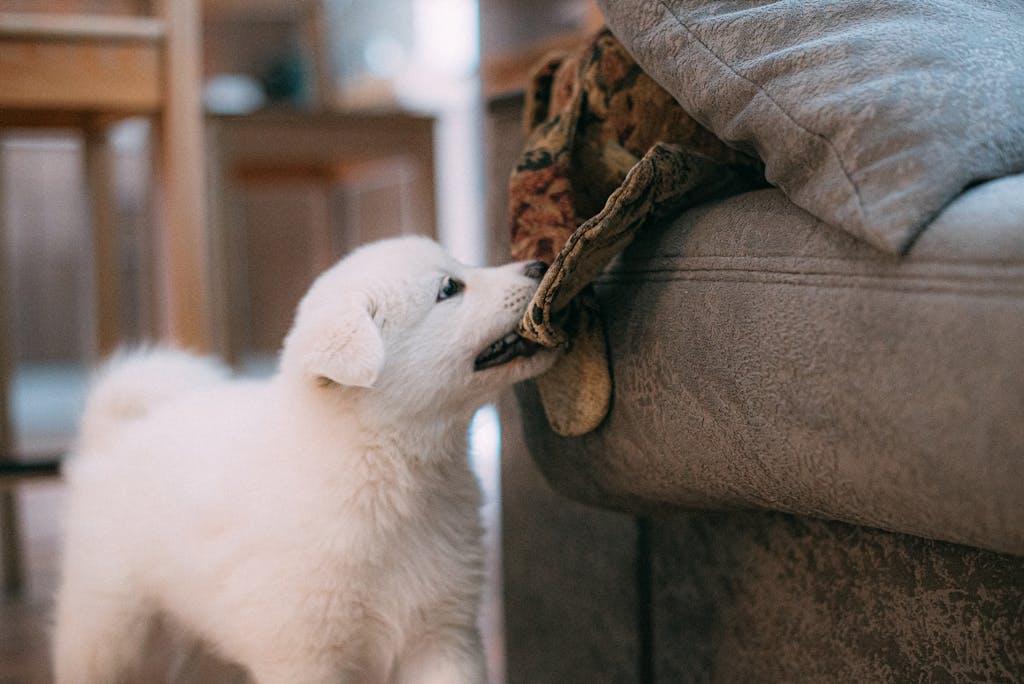
Your puppy probably left her mother a short time ago, but her mother was obviously her mother. primary attachment object.
If he is less than six months old, he needs someone to replace this primary attachment object. He will therefore choose a person who brings him warmth and comfort: he will always remain in his closest contact, which brings him the calm necessary in the face of the discovery of his new world, which is yours.
At about six months, at puberty, it is essential to proceed with the secondment. This does not mean no longer loving but rather replacing his primary attachment to a person with an attachment to the whole group, which will be indispensable for the rest of his life.
The first thing to do for this purpose is to ensure that you (and not him) are at the origin of the contacts you have with your young dog. This will allow him, for example, to remain alone, to endure your absence without developing this behaviour pathology common and well known (even if always difficult to treat): separation anxiety which causes your dog to scream, destroy or defile your apartment in your absence.
Learning about cleanliness: practical advice
When you adopt a puppy, you have to be ready to clean your garbage at home for a while because very few dogs are fit for the average age of adoption (about 2 months).
For it to become clean as soon as possible, certain rules must be respected and, above all, certain errors must be avoided.
Reward works a thousand times better than punishmentThe best reason for this is that she doesn't need to be systematic to be effective.
Tips to facilitate cleanliness learning:
- Enjoy the favorable moments : a young puppy wants to do his needs as soon as he wakes up, as soon as he has drunk or eaten. If you take him out at those times, you are very likely to do his needs exactly where you transported him, and then you can reward him with a caress for having done the right place.
- Never punish him if you haven't caught him in flagrante delicto : he might be afraid of you : even if he takes a penaud, he reacts to your expression and not to his fault. Do you doubt that? I offer to convince you to do « as if » with an imaginary defilement... He'll take the same attitude!
- Don't put his nose in it., he knows how to do it on his own without being in any way disgusted (he will do it all his life during walks): it will not tell him why you are angry.
- Use with caution the method of newsprint or alesis It will always be more difficult for him to unlearn this habit to finally learn the one that will finally satisfy you.
- You can release safely as soon as the first vaccines have been achieved, if you follow the pace of the prescribed vaccinations. Thus, he will take direct good habits and will never be afraid in the street.
- Don't pick up his garbage in front of him at home., it could take your posture at that time as a mark of interest for what he just did.
Do not hesitate to inform us of your difficulties in this area, during the vaccination consultation at the Veterinary Clinic Paris 17. This consultation is also for that!
Canine education: learning simple orders
Two simple orders are essential for a harmonious life with your dog: a call-back order and a stop signal.
There are many dogs who escaped an accident following these simple orders. It's about education and not dressage and you have to start training your puppy as soon as he gets home.
Tips for effective learning:
- Always use the same very simple words : « Star! » is as good as « Star here! » provided that it does not change.
- Education sessions must look like game sequences and must be as short as the puppy is young. At 3 months, they must not exceed 5 minutes. Don't forget that positive reinforcement is always more effective than punishment.
- Disobedience is often due to incomprehension : words have little meaning for your dog if you do not accompany them with clear gestures that it will decode faster.
- In the case of the reminder, the worst thing to do is to stand in front of your dog and threaten him by shaking his hand or shouting. Better squat and divert head by gently calling and patting your thigh « Come, Star ». Your dog will naturally want to go to you and you can then strengthen this behavior by rewarding it with vigorous caresses.
Leash walking: a necessary learning
In nature, walking on a leash does not have great meaning; So you have to teach him this new relationship that unites with you.
Progressive method for leash walking:
- For starters, put on her necklace and leave and Let him get used to this unprecedented constraint.
- When you catch the leash, Don't shoot too hard but rather give small tremors by drawing his attention by a sound signal (e.g. tongue slamming). Reward him with vigorous caresses as soon as he follows the direction of the leash a few meters.
- When he starts to gag on a leash by your side, regularly stimulate his attention by sound signals to get used to making visual contact with you: thus the physical leash doubles with a voice let.
- The leash must always be relaxed As soon as he pulls, take him dryly to the foot and relax the leash immediately by always accompanying your gesture of the same vocal order: « Star! » or « Star here! ». And congratulate him as soon as he takes a few meters without firing. If the leash is tense, it will transmit all your emotions and often trigger adverse reactions, such as aggressiveness towards its congeners.
Taking your puppy out: socialization and adaptation
There is a very high probability that your puppy will live in a very different environment than his before his adoption.
He must get used to his new environment before three months If possible, which will prevent him from being a victim of Deprivation syndrome, this very common behavioral condition characterized by a great difficulty of adaptation to the urban environment.
The only precaution to be taken is to avoid areas contaminated by unknown animals and contact with unvaccinated dogs as long as its vaccination is not complete.
If your puppy seems to you abnormally frightened on his first outings, Avoid petting him to reassure him You would reward his fear that would be strengthened. The best is to seem indifferent and to change his ideas by playing with him.
If, in spite of all the fear, he is unable to respond to your stimulations, talk to us about it at the Clinique Vétérinaire Paris 17 during a consultation specializing in behavior, we will know how to advise you to improve things.
The hierarchy: establishing clear rules
The last thing, but not least, to respect the nature of your dog, is to assign it a place in a hierarchical structure. For this, there is only one thing to do: take the place of the dominant pack and thus ensure to your dog the peace of mind that comes right back to the dominated pack.
It is the dominants who have in charge the proper functioning of the group and assign their place to each, authorizing, prohibiting, regulating daily rituals.
Of course, this authority must not be violent but rather be benevolent. No need for long speeches, just apply two simple rules:
- Feed your dog after you, without attending his meal, and share nothing at the table. He would see it as an act of submission from you.
- Don't let your dog choose a strategic place to sleep like the room or places of passage from where it can monitor the goings and comings.
Thus, by controlling these two points much more important to him than to you, you are unlikely to see your dog develop hierarchical aggressiveness.
You will sometimes have to punish him. As long as he's a puppy, do it like his mother would have done: Grab him by the skin of the neck and hang him until he calms down. At that time, rest him and stroke his shoulder, which gives him a calming signal. He will learn that you naturally consider yourself his dominant.
Conclusion
By respecting its nature and individuality, you will raise your puppy in the best of ways and you will have the pleasure of having a faithful and happy friend who will bring you all the joys you expected.
If, however, you find that your dog has embarrassing or dangerous behaviors, do not hesitate to tell us about it during a behavioural consultation at the Clinique Vétérinaire Paris 17, we will advise you.
Need help with your puppy?
- Clinical nutrition for a suitable power supply
- General consultations for regular monitoring
- Vaccines to protect your companion
- Antiparasitics for fleas and ticks
- Behavioural Pathology to solve behavioural problems